Community · October 21, 2026 · 11 min read
Whistlr's Community Guidelines, Explained: The 18+ Rule, the New Sign-Up Review and Warnings You Can Actually Understand
The Whistlr Community Guidelines, explained in plain words: the 18+ rule, the new policy review at sign-up, what's banned, how warnings work and how to appeal.
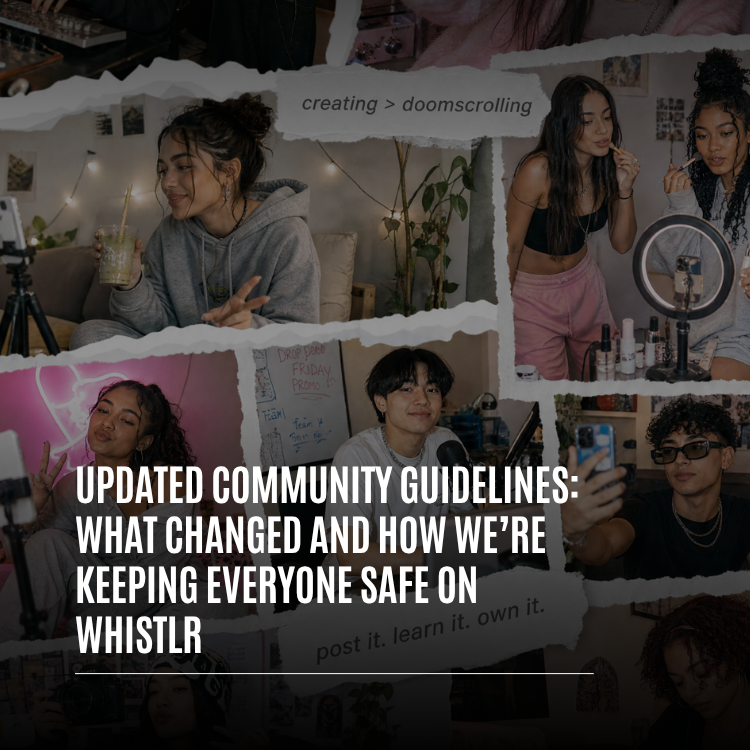
In short, the Whistlr Community Guidelines got clearer rather than tougher. New members now read every policy inside the sign-up flow before their account exists, the Terms of Service and Privacy Policy share a single revision date of August 1, 2026, and the age requirement is spelled out: you have to be at least 18. The list of banned behavior fits on one screen. Ordinary swearing no longer trips the filter, though slurs, threats, exploitation and anything pushing self-harm still do. And if a post gets stopped, the screen you see names the problem, shows how many warnings you've had and points you to a person if you disagree.
Below, we unpack each of those changes one at a time: the new review screen at sign-up, the reasoning behind an adults-only app, the short list of things Whistlr won't host, how checks run when you post, what the warning ladder looks like, and how an appeal works if your account is ever locked. We finish with a quick settings routine any member can do in a coffee break.
Why the Whistlr Community Guidelines were rewritten
Plenty of apps adjust their terms without telling anyone and count on silence. We'd rather do the opposite. An agreement only means something if the person agreeing can follow it, so we went looking for every spot where members had told us our wording was confusing, legalistic or easy to misread, and we fixed those first.
Some of the update changes the rules. A larger share changes the moments where you meet the rules: the first minute of creating an account, the second after you tap post, and the rare day something goes wrong with your account.
Rules only work when people can actually read them. We rewrote the parts that felt written for lawyers, put the full text inside sign-up, and made the warning screen explain itself. If we ever take action on something you posted, you should know exactly why and exactly what to do next.
— AJ, Founder & CEO, ETAPX
| Area | Before | Now |
|---|---|---|
| Policy dates | Hard to tell which version applied | Terms and Privacy Policy both dated August 1, 2026, with the date shown in the app |
| Sign-up | A checkbox and a link | A dedicated review step with every policy readable in full |
| Age | Implied | Explicitly 18 and over, with a birthdate check |
| Banned content | A long, dense list | A short list you can read in about a minute |
| Profanity | Often flagged | Allowed, unless it targets people |
| Held-back posts | A vague error | A sheet naming the category, your warning level and how to dispute it |
| Contact | Several inboxes | One address, hq@etapx.pro, for legal, privacy, safety and support |
What the sign-up policy review looks like
The final screen before a new account goes live now resembles a tidy settings menu. Each policy sits on its own row with an icon, a name and a one-line summary. Tap a row and the entire document opens in a sheet, unabridged, so you can scroll through it before you commit to anything.
Three groups of policies
- Terms group: Terms of Service, Eligibility & Your Account, Community Standards, Content Ownership, and Safety & Legal.
- Privacy group: Privacy Policy, Your Data & How We Protect It, Security & Data Protection, and You're In Control.
- More group: Minors & Parental Responsibility, Purchases, Commerce & Refunds, and Contact Us.
Two boxes you tick yourself
Underneath the rows are two separate confirmations. One says you are 18 or older; the other says you accept the Terms of Service and the Privacy Policy. The button that finishes sign-up stays hidden until both are checked, which is a deliberate swap for the catch-all line many apps print in tiny type under their Continue button.
It makes no difference which door you come in through. Email sign-up in the app, sign-up on the web, and joining with an Apple or Google account all land on the identical review, with the same full documents and the same two boxes. Using an outside account never lets anyone bypass it.
Why Whistlr is 18+ only
Creating an account starts with your date of birth. Enter one that makes you younger than 18 and sign-up ends on the spot, with a message explaining the minimum age. Everyone who continues also confirms their age directly, and the screen warns that accounts later found to belong to minors can be banned or removed for good.
The reason is practical. A large part of Whistlr involves money and commitments that make sense for adults: going live, sending and receiving Gems and Tips, Vault subscriptions, Storefronts and the business toolkit. Drawing a clear age line lets us build those features for the audience they're actually meant for.
Guidance for families
The Minors & Parental Responsibility policy speaks to parents and guardians directly. If you think a child in your care is on Whistlr, it asks you to delete the account, uninstall the app from their phone or tablet, and tell us at hq@etapx.pro. We'd add two things: switch on the parental controls built into the device, and keep talking with young people about what they do online. An age gate helps, but an engaged adult helps more.
Protecting minors goes beyond the age gate
Being adults-only doesn't mean we stop thinking about children. The Safety & Legal section describes our commitments under the Children's Online Privacy Protection Act (COPPA), the Kids Online Safety Act (KOSA) and the KIDS Act. In practice that means hunting down and removing accounts held by minors, banning any content aimed at or endangering young people, and working fully with police whenever a child's safety is involved.
Anyone caught grooming, exploiting or putting a minor at risk is removed permanently and referred to the relevant authorities, which include the National Center for Missing & Exploited Children (NCMEC).
What the Whistlr Community Standards ban
The Community Standards are the core of the guidelines, and we trimmed them so a member can actually keep them in mind. Here is everything that is off-limits:
- Harassing, bullying, threatening or intimidating anyone.
- Hate speech, including attacks on people because of protected characteristics.
- Breaking the law, or encouraging others to.
- Pretending to be someone else, or running a fake identity.
- Spam, scams and other deception.
- Bots, scrapers and other automation we haven't approved.
- Encouraging self-harm or dangerous stunts.
- Explicit sexual material, nudity or adult content.
- Sharing other people's creative work without the right to do so.
Break one of these and enforcement follows, which can go as far as removing the account forever. We kept the phrasing plain because rules that need interpreting end up enforced differently for different people, and that kind of inconsistency erodes trust faster than almost anything.
The violations with no second chance
A handful of offenses skip warnings altogether and end in permanent removal: child sexual abuse or exploitation, grooming or soliciting minors, credible threats of violence, promoting terrorism, and serious crimes such as trafficking or selling drugs or weapons. There is no appeal for these, and we notify the authorities whenever the law requires it.
How Whistlr content moderation checks your posts
We rely on two layers working together: automated checks and people reviewing what those checks and our members flag. We move fast, but no team on earth can look at every single upload the instant it appears, and the Safety & Legal section says so honestly.
Checked on the way out
Hitting post, comment, send or share kicks off a quick review before your content reaches anyone. Words are screened for the kinds of language described below. Pictures and videos are screened for nudity, graphic violence, hateful symbols and obscene gestures. Pass, and your content is live immediately. Fail, and nothing is published; instead you get an explanation.
Things can still be taken down later. If something slips through and turns out to break the rules, it can be removed after the fact and the account owner told. Member reports go into exactly the same review.
Swearing is fine; targeting people isn't
Our older text filter was heavy-handed and caught harmless cursing. That's been dialed back. Profanity on its own no longer counts against you. The text check now concentrates on six kinds of genuinely harmful language:
| What the text check looks for | Examples of what that means |
|---|---|
| Racist or discriminatory language | Slurs or attacks tied to race or ethnicity |
| Sexist or discriminatory language | Attacks tied to sex or gender |
| Hateful or offensive language | Going after someone for who they are |
| Threatening or violent language | Threats, including urging someone to hurt themselves |
| Sexual exploitation | Exploitative or abusive sexual content |
| Content promoting self-harm | Encouragement or instructions to self-harm |
Supportive posts about self-harm are welcome
There's a world of difference between glorifying self-harm and talking honestly about it. Members share awareness campaigns, crisis-line numbers, therapy milestones, recovery stories and memorials, and we want those posts here. When a post clearly signals that supportive purpose, through words about prevention, healing, recovery, grief or remembrance, the self-harm check treats it accordingly. That allowance never covers threats at another person: telling someone to end their life is handled under a separate rule and is never excused.
How the moderation warning sheet works
If something you tried to share is stopped, a full-height sheet slides up. We designed it to sound like a note from a colleague rather than a system error.
First, it identifies the issue by name, for instance "An inappropriate image or video," and reassures you nothing was published. When the problem doesn't fit one of the named categories, it says more generally that the post conflicts with our Community Guidelines. Either way, you know what to change.
Second, it tells you which rung of the warning ladder you're on:
| Rung | What the sheet tells you |
|---|---|
| 1. Content removed | Nothing was shared, and you are free to edit and try again |
| 2. Second warning | Another violation may restrict what your account can do |
| 3. Final warning | One more violation can lead to suspension |
Third, it gives you two ways forward: a button that opens the complete Community Guidelines inside the app, and an invitation to email hq@etapx.pro if you believe the call was wrong. A member of our team reads those messages.
How to appeal a locked Whistlr account
Serious or repeated breaches can lead to a lock. If that happens, opening Whistlr brings up a dedicated screen that states why. It is designed as a starting point, not a wall:
- Write an appeal right there, giving your side of the story with specific details.
- Watch it move between three states: pending, approved or declined.
- If it's declined, read the reasoning and send a fresh appeal with additional context.
Status changes show up live. An approved appeal unlocks the app without forcing you to sign out first. Almost every enforcement decision can be appealed; the zero-tolerance offenses described earlier are the only ones that are final.
Your data rights and our response times
The You're In Control policy lists what you can ask of us: see your data, fix it, erase your account and data, limit how it's used, take a portable copy, object to particular uses, and pull back consent. We commit to answering ordinary requests inside 30 days and urgent safety matters inside 72 hours. One more option worth knowing about: if you would prefer any dispute to go to court instead of binding arbitration, Safety & Legal explains that you can opt out by emailing hq@etapx.pro within 30 days of opening your account.
What the guidelines promise about messages, data and shopping
The guidelines cover our behavior as well as yours. The Privacy policies describe what we gather, the reasons, and the switches you control. One commitment stands out: we don't read your private messages to target ads, and their content isn't used for advertising at all.
Messages are checked for harm before delivery so that abuse never lands in someone's inbox; that check is about protection, not profiling. Security & Data Protection also explains how your account details are shared between ETAPX products so one login works across them, and how to narrow that sharing.
For shoppers, Purchases, Commerce & Refunds lays out the rules for Storefronts, paid streams and other things you can buy from businesses on Whistlr. Every selling account must be verified and operate within the law. Refunds are judged individually and may be granted for orders that never arrived, items that differ significantly from their listing, or charges you didn't authorize. Honest sellers are shielded from bogus disputes, and dishonest ones face enforcement.
A five-minute safety routine for every Whistlr member
Rules set expectations, but the safety you notice day to day mostly comes from settings you control. Here's a short routine that ties the two together:
- Skim the Community Standards in the Help Center or a group chat's info screen.
- Open Settings, then Privacy and safety, and decide whether to go private so that only approved friends see your posts and stories.
- In Contact options, choose who may message you (everyone, people you follow, verified accounts only, or nobody) and whether others can drop you into group chats.
- Pick Everyone, Peers only or No one for tags and mentions.
- Follow the advice in Eligibility & Your Account: use a strong password and switch on two-factor authentication.
- Locate Report on posts, stories, comments, profiles and messages before you need it. Story reports let you choose a reason such as nudity, hate symbols, violence or harassment.
Blocking rounds it out. It quietly takes someone out of your Whistlr experience, and you can undo it later if you change your mind.
Habits that keep you clear of trouble
- Write about mental health, grief and recovery with care, and add helpline details when it makes sense.
- Curse as much as you like, but never aim it at who someone is.
- Keep nudity and sexual content off posts, stories, streams and DMs.
- Only share creative work you made or have permission to use, and credit the original creator.
- When a post is stopped, change it based on what the sheet says rather than trying it again unchanged.
- Make appeals concrete. Specifics help a reviewer see what really happened.
- If someone crosses a line, block or report them instead of firing back.
Frequently asked questions
What's different in the updated Whistlr Community Guidelines?
Sign-up now includes a screen where you read every policy in full, the Terms and Privacy Policy share an August 1, 2026 revision date, the 18+ requirement is explicit, the banned-content list is shorter, minors get stronger protection, casual swearing is allowed, and a stopped post now comes with a sheet explaining the reason and your warning level.
What is the minimum age for Whistlr?
Eighteen. New members enter a date of birth and tick a box confirming they meet the age requirement, and anyone later found to be younger can lose their account permanently.
Can I swear on Whistlr?
Yes. Profanity by itself is not against the rules. What gets stopped is language aimed at people: slurs based on race, sex or gender, hateful attacks, threats, sexual exploitation and encouragement of self-harm.
What happens when Whistlr stops one of my posts?
Nothing is published, and a sheet tells you which category was matched. On a first offense you can simply edit and resubmit. Further violations bring a second and then a final warning, after which your account can be restricted or suspended.
Can I get a locked Whistlr account back?
Usually, yes. The screen you see when your account is locked lets you file an appeal and track it live as pending, approved or declined; a declined appeal can be followed by a new one with more detail. Zero-tolerance offenses are the exception and are final.