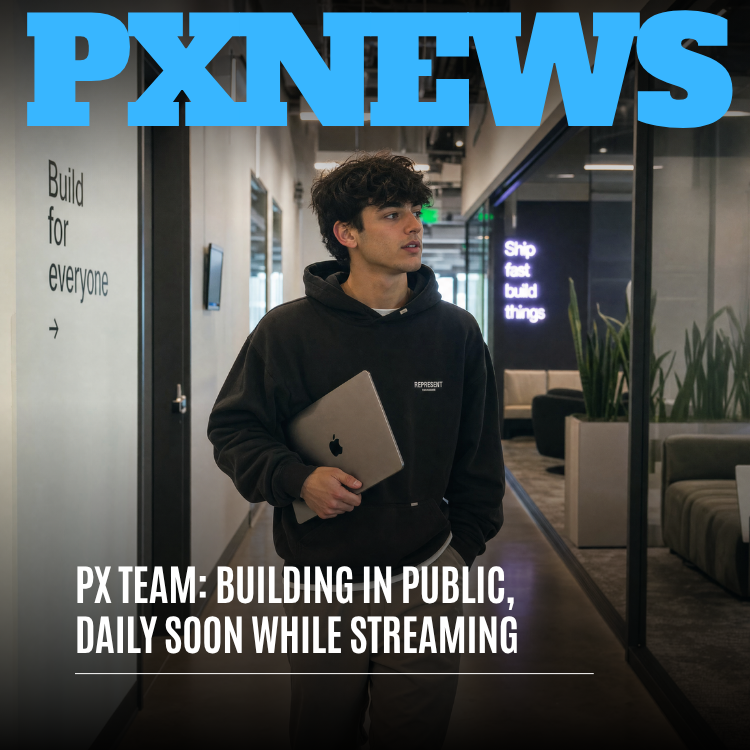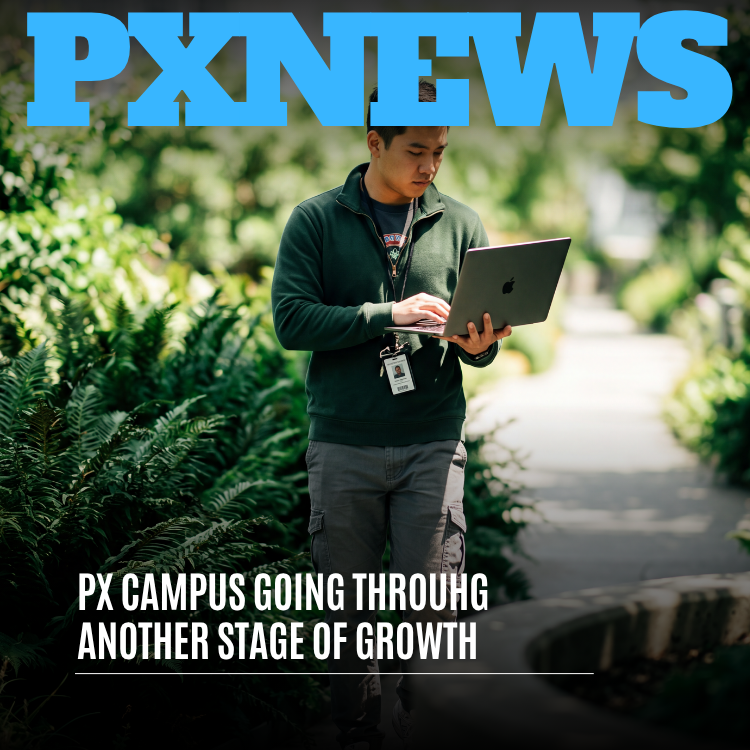
Company · September 24, 2026 · 12 min read
Scaling Startup Culture: How PX Campus Is Growing Without Splitting Into Silos
Scaling startup culture is the hard part of growing. How PX Campus onboards, organizes pods and keeps context flowing so Whistlr and the lineup get better.
Scaling startup culture is the part of growth nobody can buy. PX Campus, the Bay Area home of the team building Whistlr, GLSRM, Ocsidian, Influxx and in.between, is going through another stage of growth, and the real challenge isn't finding desks. It's keeping the habits that made ETAPX good: unscheduled collisions between teams, decisions made in the open, and candid feedback. Our approach comes down to a handful of deliberate defaults covering how new people are onboarded, how teams are shaped, how context travels and what we refuse to add. This piece explains each one, and why it matters to you if you've never set foot in the building.
We've written before about why we invest in a physical campus and why proximity is part of how we work. This isn't that story again. This is the operating manual for the growth stage itself: the mechanics, the tradeoffs and the things we're actively saying no to. We're not publishing headcount, funding or office announcements here. Numbers about team size have a way of becoming the story instead of the work, and the honest version of this stage is still unfolding.
What is changing on PX Campus right now?
"PX Campus" has always meant two things. It's the literal place where the ETAPX team works, a Bay Area headquarters that AJ, our founder and CEO, chose on purpose over a remote-first default. And it's shorthand for a culture: the open, argumentative, show-your-work way the company builds. Both halves are stretching at the same time.
The physical half is easy to see. There are more people on the floor than a few seasons ago, and more of them are working on problems that weren't full-time jobs until recently. Teams that used to be two people have become real pods with their own rhythm. The whiteboards fill up earlier in the day.
The cultural half is harder to photograph, and it matters more. Growth is the moment a company either protects the habits that made it good or quietly trades them for process. That's why we frame this stage as a culture problem first and a hiring problem second.
Why ETAPX is growing now: hiring ahead of need
Growth at ETAPX has never been a goal on its own. We don't add people so the company looks bigger. We grow when the products outgrow the people available to look after them properly, and several forces have been pulling at once.
- A wider lineup. in.between and Nalani brought an entirely new discipline into the company: building an AI companion designed to listen more than it talks. A new category of product brings new kinds of work.
- Deeper products. Whistlr has grown from a social feed into a full platform with Circuits and SubCircuits, Waves, Minis, Creator Studio, Flow, Storefronts, Live Shopping, Halo, Profile Skins and relationship status. Each is an ongoing responsibility, not a one-time launch. The same is true of Podz inside Influxx and GLSRM's mobile presence.
- A bigger, more international community. Whistlr's international expansion and growing userbase raise the bar for safety, support, reliability and polish.
- A preference for hiring ahead of need. We'd rather add capacity before it becomes an emergency than scramble after something breaks.
That last one is the choice people outside the company tend to miss. It's tempting for a startup to wait until a team is visibly drowning before adding anyone, because waiting feels frugal. In practice, the people already stretched thin end up spending months onboarding newcomers while also keeping everything running, and quality quietly slips in the gap. AJ has pushed the other way: grow before the pressure peaks, so new people have room to actually learn the product before they're asked to carry it.
Hiring after the fire starts means the people holding the hose also have to train the new firefighters. We'd rather bring people in while there's still time to show them around properly.
— The ETAPX team
How PX Campus has scaled its culture before
This isn't the first time the campus has changed shape, and the earlier stages explain why this one feels the way it does.
| Stage | What it looked like | What it gave the culture |
|---|---|---|
| Single product | One team, one idea, one table. A decision on Monday morning was common knowledge by Monday afternoon. | Directness, speed and a low tolerance for decisions made behind closed doors |
| Multiple products | Whistlr joined by GLSRM, then Ocsidian and Influxx, sharing one floor and one kitchen | "Collisions": unplanned hallway conversations where one team's fix solves another team's bug |
| Maturity (now) | Every product has enough users, features and history to need specialists who go deep on one surface | The chance to specialize, and the risk of fragmenting into silos that share a lobby |
The collisions in the second stage are worth dwelling on, because they're the thing this stage puts at risk. The classic example: an Influxx engineer overhears a Whistlr bug at lunch and realizes it's the same one they fixed in Podz the week before. That kind of moment doesn't show up on any org chart, and it has become one of the company's biggest structural advantages. Everything we're doing now is aimed at getting the benefits of specialization without losing those moments.
The real problem with scaling startup culture: communication paths
When people talk about scaling startup culture, they usually mean values, vibes or perks. We've found it's mostly a plumbing problem. Every new person adds new connections between people, and each connection either carries context or loses it. Five people can keep everything in their heads. Fifty cannot. Somewhere in between, a team stops knowing why things are the way they are, and starts relearning lessons the building already learned once.
So the question we keep asking isn't "how do we preserve the vibe?" It's "how does context keep flowing?" Concretely: does the person fixing a caching issue in GLSRM know the Whistlr team solved something similar? Does a new designer on in.between know why Creator Studio moved to its own home? If the answer depends on being in the right meeting, the culture is already leaking.
Five defaults we're protecting while PX Campus grows
Here are the specific habits we're leaning on during this stage, and why each one exists.
1. Shared spaces stay shared
The kitchen, the common areas and the long tables are deliberately not divided up by product. A GLSRM editor and an Ocsidian engineer should keep bumping into each other, because that's where some of the best cross-product ideas have always started. Carving the floor into product zones would be tidy, and it would quietly end the collisions.
2. New people see the whole company
People joining now get a real tour of every product, not just the one they were hired for. You can't have a useful hallway opinion about Whistlr's Storefronts if you've never opened them.
3. Decisions stay visible
The show-your-work norm matters more as the room gets bigger. Design reviews, tradeoffs and the reasoning behind a call get written down where anyone on campus can read them, so nobody has to be in the right meeting to understand why something shipped the way it did.
4. Candor comes with context
A small team can get away with blunt feedback because everyone already trusts each other. A bigger team has to build that trust faster. The norm is still candid, but candid with context: say what's wrong, say why, and assume the other person wants the product to be good as much as you do.
5. Small pods over big departments
Where possible, teams grow as small, focused pods that own a specific surface end to end, rather than large departments handing work back and forth. Small groups argue faster, ship faster and stay closer to the people using what they build.
How onboarding works on PX Campus during this stage
A company's growth stage shows most clearly in how it treats someone's first week. Ours is built around one idea: new people should understand why things are the way they are before they're asked to change them. That doesn't mean waiting around. It means getting context quickly.
- Use everything. New team members start as users: posting on Whistlr, joining a few SubCircuits, reading GLSRM like a regular reader, trying an Ocsidian project, opening Influxx and Podz, and spending a few nights with in.between and Nalani. The goal is to feel the products before seeing them as code or design files.
- Read the history. Much of the reasoning behind major decisions, like why Creator Studio moved to its own home, why some Whistlr development focuses on the latest iOS and why in.between shipped deliberately narrow, is written in PX News. New people read it the same way you can, which keeps the internal story and the public story aligned.
- Sit in on the collisions. Newcomers spend time around teams they won't work with directly. Watching how GLSRM makes editorial calls, or how the Whistlr team debates a feed change, teaches more about our values than a slide deck.
- Ship something small, early. New people are pointed toward a real, small, useful change, like a polish fix, a copy improvement or a performance tweak, so they experience the full loop of building, reviewing and releasing before taking on anything bigger.
Picture someone's second week. They joined to work on Whistlr's live tools. On Tuesday they shipped a tiny copy fix to a settings screen. On Wednesday they ate lunch next to two people from the GLSRM team arguing about a headline, and left knowing more about how the company thinks about trust than any handbook could have told them. On Thursday they spent an evening journaling with in.between to understand what the newest product feels like from the inside. That's the onboarding working as intended.
What scaling startup culture means for the products you use
It's fair to wonder why any of this matters if you just want your Whistlr feed to load quickly or your in.between journal to remember what you said last week. The connection is direct. When teams are sized properly and context keeps flowing, specific things improve.
| What changes inside | What you notice outside |
|---|---|
| Teams have room to return to rough edges | Fewer stuttering transitions, hard-to-find settings and notifications that fire one time too many |
| More people behind trust and safety, moderation and support | Safety and support keep pace as the Whistlr community grows |
| Round-the-clock security and infrastructure don't rest on the same few people | Steadier reliability, including late at night |
| More of the team close to the community | A shorter gap between someone noticing a problem and someone working on it |
| Specialists sitting near each other | Solutions and design language shared across the lineup more often |
Put simply, this stage isn't about ETAPX getting bigger for its own sake. It's about the products getting the care their users have earned. Expect steady refinement across what already exists, not a flood of unrelated launches. That's deliberate.
What we're saying no to while we grow
Every growth stage comes with temptations. A bigger team can easily become an excuse to do more things instead of doing the important things better. PX Campus is growing to deepen what exists, not to scatter energy across a dozen new bets. So we're holding a few firm lines.
- No growth for appearances. Roles aren't added to make the company look larger or to match what other startups are doing. Every addition should map to a real need in a real product.
- No layers for their own sake. Process should remove friction, not create it. When a new review step or approval gate is proposed, the first question is whether it protects quality or just slows people down.
- No trading culture for speed. If growing faster meant abandoning visible decisions, shared spaces or candid feedback, we'd rather grow a little slower.
- No overpromising in public. PX News keeps covering what actually happened, including the parts that take longer than planned.
Busy seasons are when culture erodes, because every shortcut feels justified at the time. The version of ETAPX people trust was a small team that argued in the open and finished what it started. A bigger campus has to keep doing both.
— The PX team
Where the Bay Area campus goes from here
Keeping a real headquarters shapes how this stage looks. A remote-first company grows by adding more video calls. PX Campus grows by adding people to the room where collisions happen, which changes the character of the growth entirely.
There's a longer-term idea attached, too. AJ has been open that the headquarters shouldn't remain a private space that only employees ever walk into. Small meetups with members of Campus, our Discord community, are an early and deliberate step toward a headquarters that eventually hosts events and welcomes creators and community members. Growth is part of what makes that possible: a bigger, more established team can eventually open its doors in a way a small, stretched team never could. We're describing a direction here, not announcing dates.
Nobody on the team would call this stage finished. Growth here has always been iterative: the company expands, checks which habits survived and which need reinforcing, and adjusts before the next stage. Some things that work today will need to change, and we fully expect to learn a few lessons the hard way. The standard underneath stays the same. PX Campus works best when people are close to each other, close to the products and close to the community using them.
How to follow PX Campus as it grows
If you use any ETAPX product, this stage reaches you in small ways that add up. Here's what to expect and where to watch:
- More of the team in public. As the team grows, more of the people building the products will show up on the ETAPX YouTube channel at youtube.com/@etapx-inc, in Campus on Discord and in PX News coverage.
- Faster responses in Campus. The feedback, beta and early access channels at discord.gg/etapx get more useful the more people on the team are reading them.
- More behind-the-scenes stories. A growing campus has more worth telling, and the team plans to keep sharing them through PX News and video.
- Steady, focused improvements across the products you already use.
Frequently asked questions
What is PX Campus?
PX Campus is ETAPX's physical headquarters in the Bay Area, where the team building Whistlr, GLSRM, Ocsidian, Influxx and in.between works. It's also shorthand for the company's culture: an open, direct, show-your-work way of building products. It's separate from Campus, ETAPX's official Discord server, though both share the same community-first spirit.
Why is PX Campus growing now?
Because the products have grown. A wider lineup that now includes in.between and Nalani, a much deeper Whistlr platform and a larger, more international community all need more people to look after them properly. ETAPX also prefers hiring ahead of need, so new team members can learn the products before teams become stretched thin.
How does ETAPX approach scaling startup culture?
By protecting small, specific defaults rather than relying on one big initiative. Shared spaces stay shared across products, new people see the whole company, decisions are written down where anyone can read them, feedback stays candid but comes with context, and teams grow as small pods. The aim is specialization without losing cross-team collisions.
Is ETAPX announcing a headcount or a new office?
No. This is a look at how the current stage of growth is being managed, not a headcount milestone, funding news or an office announcement. ETAPX deliberately avoids publishing team-size numbers, partly because they tend to overshadow the work, and prefers to show growth through the quality of its products.
How does PX Campus growth affect Whistlr users?
Properly sized teams have more time for polish, stronger safety and support, steadier reliability and faster responses to feedback in Campus. Users should expect steady, focused improvements across Whistlr and the rest of the lineup rather than a rush of unrelated launches. Growth is meant to deepen what already exists.