Company · September 23, 2026 · 12 min read
Building in Public, Every Day: What the PX Team Will Show on Stream and What Stays Off Camera
The PX team is building in public with daily streams coming soon. What you'll see, what never goes on camera, where to watch, and how to take part in the work.
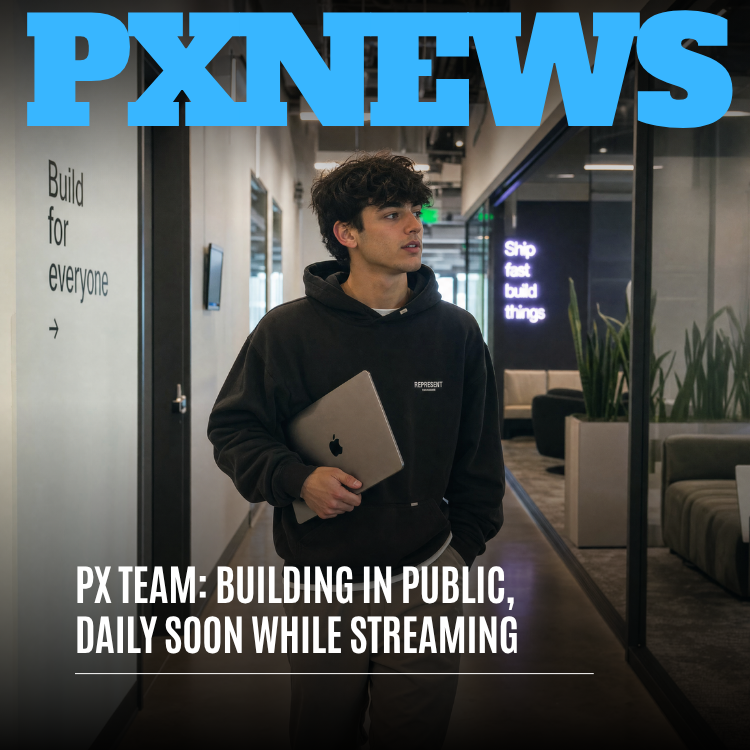
Building in public, for the PX team, is about to mean something very literal: daily live streams, coming soon, showing the real work of making Whistlr, GLSRM, Ocsidian, Influxx and in.between as it happens. You'll be able to watch engineers work through bugs, designers argue about layouts and product leads talk through a decision before it's final, on YouTube, on Whistlr and with the conversation running in Campus on Discord. We haven't announced a start date or a schedule yet. What we can tell you now is what the streams are for, what they'll include, and the lines we won't cross while the camera is rolling.
That last part deserves as much attention as the rest. Streaming a working company every day sounds simple until you think about everything that passes across a developer's screen in a normal afternoon. So this article is partly a viewer's guide and partly an explanation of the rules we're setting for ourselves before we go live. If you've ever wanted to see how an app you use actually gets made, or you're a founder wondering whether building in public is worth the risk, this is for you.
What does building in public mean at ETAPX?
In startup circles, "building in public" often means a revenue screenshot, a teaser of a nearly finished feature or a thread about lessons learned. That's fine, but it shows outcomes. For the PX team, building in public means showing how the work actually happens: the reasoning behind decisions, the tradeoffs being weighed, the ideas that don't survive and the ordinary, unglamorous hours that make software good.
We didn't arrive at this suddenly. It's a continuation of things ETAPX already does. We run our own newsroom in PX News. We post product walkthroughs and founder updates on the ETAPX YouTube channel. We answer questions directly in Campus, our official Discord server, instead of routing everything through a ticket queue. And AJ, ETAPX's founder and CEO, has written openly about his belief that a company willing to show its actual thinking will out-earn one that only ever shows a highlight reel.
Each of those formats has a limit. An article describes a decision after it's made. A video shows a feature once it's finished. A live stream lets you watch the decision being made, and sometimes lets you say something before it's final. That's a much shorter distance between the people building a product and the people using it, which is the relationship we've been trying to build from the start.
A finished feature tells you what we decided. A stream tells you why, including the three versions we threw away first. We think the second one is more useful, and a lot harder to fake.
— The PX team
Why building in public every day, not once a quarter
We considered doing occasional livestreams around launches. We decided against it. A stream once a quarter is an event, and events get scheduled around the moments a company wants to look good. A daily presence is a relationship. We want you to be able to drop in on an ordinary Tuesday and see what an ordinary Tuesday at ETAPX looks like.
The timing also lines up with where the company is right now:
- The team is growing. PX Campus is going through another stage of growth, with more people and more specialists across more products. There's more worth showing, and making the process visible keeps us honest while we grow.
- The products are deeper. Whistlr spans Circuits and SubCircuits, Waves, Minis, WTC Gems, Creator Studio, Flow live streaming, Storefronts, Live Shopping, Halo and more. Influxx has native apps, ADE and Podz. in.between and Nalani introduced a new kind of AI companion. The more a product does, the more it helps to see how its builders think.
- Video has proven itself. The ETAPX YouTube channel moved past its trial stage because walkthroughs and behind-the-scenes explanations genuinely helped people. Live is the next format.
- People asked. In Campus, people regularly ask how a feature was built, why a design changed or what the team is working on right now. Streams answer at the source.
What you'll see on the PX team's building in public streams
The streams are meant to reflect the real range of work, not just the parts that look impressive on camera. Here's what the team is planning as daily streaming rolls out, and who each kind of session is likely to help most.
| Segment | What happens | Most useful for |
|---|---|---|
| Live build sessions | Engineers work through real features, fixes and performance improvements, explaining their thinking out loud | Developers, students, curious users |
| Design reviews | Designers walk through layouts, interactions and visual choices, including options that get cut and why | Creators, designers, anyone who's wondered why a screen changed |
| Product decision walkthroughs | Product leads explain what feedback came in, what need sits under it and how a feature might be shaped to meet it | Creators, business users, founders |
| Bug triage and polish passes | Finding rough edges and smoothing them out, often with nothing new launching at all | Everyday users who care about reliability |
| Community Q&A | The team answers questions from viewers and from Campus in real time | Everyone |
| Cross-product conversations | People from the Whistlr, GLSRM, Ocsidian, Influxx and in.between teams compare notes | Founders, developers, people interested in how ETAPX works |
Not every day will look the same, and not every stream will include all of these. Some sessions will be long, focused working blocks with occasional commentary. Others will be short conversations. We'd rather the format follow the real shape of the work than force it into a rigid show.
A week of streams, imagined
Here's how a thread might run across several days. On Monday, a designer opens a stream by pulling up Campus feedback saying a particular Whistlr screen feels cluttered. Instead of "move this button," the designer frames the underlying problem out loud: people can't find what they need fast enough. They sketch two or three alternative layouts, talk through the tradeoffs and ask viewers which one matches how they actually use the app.
On Thursday, an engineer picks up the chosen direction, starts implementing it and hits an edge case on a smaller screen. They work through it live. Viewers have now watched one change move from a complaint in Discord to a sketch to working code. When it eventually ships, the PX News write-up and any YouTube walkthrough will feel familiar to a lot of people, because they saw it being made.
What stays off camera when we're building in public
Building in public doesn't mean streaming everything. Being open about our process only works if it never comes at the expense of the people who use our products or the people who build them. These are the lines, and they don't move.
- User data and private content. Nothing that exposes a user's private information, messages, account details or journal entries will ever be shown. in.between entries are private by default, and a camera doesn't change that. The same goes for private content on Whistlr.
- Security-sensitive work. Security at scale is a round-the-clock responsibility at ETAPX, and some infrastructure and security work can't be shown publicly without creating risk.
- Individual trust and safety cases. Moderation decisions involve real people in real situations. The team can talk about principles and approach, never specific cases.
- Partners' confidential plans. When we work with creators, artists and businesses, their plans are theirs to announce. We won't reveal anyone's work before they're ready.
- Team members who'd rather not appear. Streaming is an invitation, not a requirement. Plenty of great work happens off camera, and nobody's contribution is measured by screen time.
These boundaries aren't a contradiction of building in public. They're what make it sustainable. Visibility that puts users or teammates at risk isn't transparency. It's carelessness, and it would destroy exactly the trust the streams are meant to build.
How we're preparing to stream real work safely
Streaming your actual work responsibly is its own engineering discipline, which is a big reason the streams are "coming soon" rather than already running. Before we go live daily, the team is setting up safe streaming environments: knowing which screens are safe to share, which working environments hold nothing sensitive, and where the line falls between explaining how a system works and exposing something that should stay protected.
We're also figuring out a rhythm the team can genuinely sustain. A daily commitment that burns people out in a month would be worse than no commitment at all. And we're thinking about keeping the content useful rather than repetitive, so an ordinary day is still worth dropping in on.
The hard part of streaming your work isn't the camera. It's knowing exactly what's on every screen before you share it. We're getting that right first, because trust is the one thing we can't afford to leak.
— The PX team
Where to watch the daily streams and how to follow along
The streams will live on channels ETAPX already uses, so there's no new destination to learn. Exact schedules and the specific mix of platforms will be confirmed as the streams roll out. Here's how to be ready for the first one.
- Subscribe on YouTube at youtube.com/@etapx-inc and turn on notifications, so you hear when the team goes live instead of finding out afterward. Where it makes sense, highlights or recordings may be available there too.
- Follow ETAPX on Whistlr. Flow is Whistlr's own live streaming experience, and it makes sense for the team to show up where creators and users already go live every day.
- Join Campus at discord.gg/etapx. That's where stream announcements, discussion threads and follow-up questions will live, alongside the existing feedback and beta and early access channels.
- Bring questions. Some of the best segments will come from things the team didn't anticipate, whether that's a feature you want explained, a decision you want the reasoning behind or a bug you keep hitting.
- Keep reading PX News. Streams show work in motion. PX News keeps the written record of what was decided, in a form you can link to and reread.
How to get the most out of building in public streams
Watching someone code or debate a layout for an hour is a different experience from watching a finished video. A few habits make it more rewarding.
- Drop in, don't binge. You don't need to watch every minute. Catch the part of a session that matches what you care about.
- Follow a thread across days. The most satisfying viewing comes from watching one change move from feedback to design to code to release.
- Ask why, not only what. "Why did you cut that option?" usually gets a more interesting answer than "when does this ship?"
- Take discussion to Campus. Live chat moves fast. If a question needs a real answer, post it in Campus where the team can follow up properly.
- Watch the boring sessions sometimes. Polish passes and bug triage are where a lot of quality actually comes from, even when nothing new launches.
Who the building in public streams are for
The streams are for anyone who uses an ETAPX product, but a few groups will probably get the most out of them.
- Whistlr creators who rely on Creator Studio, Flow, Minis, Storefronts and Live Shopping can see how those tools are designed and improved, understand what's coming and give feedback that shapes it.
- Developers and builders interested in agentic tools like Influxx and ADE, or Ocsidian's approach to game creation, can watch how the team works alongside AI rather than treating it as a replacement for skill.
- Startup founders can see a working example of choosing visibility, which AJ has openly encouraged other startups to do, including the boundaries and the day-to-day reality.
- Students and people curious about tech careers can watch how engineers debug, how designers critique and how decisions get made, which is hard context to get anywhere else.
- Everyday users who've wondered why an app they use changed can hear the answer from the people who made the call.
How streams fit with PX News, YouTube and Campus
ETAPX now has several ways of sharing what it's building, and each does a different job. Knowing which is which makes it easier to find what you want.
| Channel | Its job | Go there when you want |
|---|---|---|
| PX News | The written record: explanations, announcements and honest updates, including what took longer than planned | Something you can quote, link or reread |
| YouTube | Finished video: product walkthroughs, founder updates and behind-the-scenes explanations | A clear, edited explanation of something |
| Daily streams | Work in motion: the live, unedited process, with room to participate | To watch a decision take shape |
| Campus on Discord | The conversation: real-time discussion, questions, feedback and beta access | To ask, respond or test something early |
None of these replace each other. A decision you watch on a stream might later be explained in PX News and demonstrated on YouTube, with the discussion happening in Campus the whole way through. When someone watches the team work through a problem and then asks about it in Discord, the distance between having a thought and being heard by the person who can act on it gets very small. That's what Campus was built for in the first place.
Why we think building in public makes the products better
It would be easy to read daily streaming as marketing. That isn't how the team thinks about it. Working in the open has practical effects on the quality of what ships.
Cheaper mistakes
When people can watch a feature take shape, they can say "that's not how I'd use it" before it ships instead of after. It's the same principle behind Campus's feedback and beta channels, compressed further. Catching a misunderstanding in a design review costs far less than fixing it in an update.
Clearer thinking
Explaining your reasoning to an audience forces clarity. If a decision is hard to justify on stream, that's often a sign it deserves another look. Over time, that makes the products more coherent.
Visible follow-through
A company that shows its work is easier to hold to its word. If the team says a polish pass is happening, you'll be able to watch it happen. That kind of follow-through is how trust builds.
Collisions beyond the building
Streams also let people inside ETAPX see what other teams are doing. An Ocsidian engineer catching a Whistlr stream might spot the answer to their own problem, which extends the hallway collisions that make PX Campus work past the walls of the office.
We expect the format to change once it starts. The first streams will teach us what people find valuable, what they skip and what they want more of. Some segments will become fixtures and others will fade, and that iteration will happen with the community watching too. What won't change is the commitment underneath: the companies that earn lasting trust are the ones willing to show their actual thinking, and streaming the work every day puts that belief on the line.
Frequently asked questions
What does building in public mean at ETAPX?
Building in public at ETAPX means showing how the PX team actually builds its products, including the reasoning, tradeoffs, design debates and everyday work, not just finished features. It continues what the company already does through PX News, the ETAPX YouTube channel and Campus on Discord, and extends it into daily live streams that are coming soon.
When do the PX team's daily streams start?
The daily streams are coming soon, but no start date has been announced. The team is first setting up safe streaming environments and a schedule it can genuinely sustain. Specific timing will be shared through Campus on Discord, the ETAPX YouTube channel and PX News once the details are final, rather than promised ahead of time.
Where can I watch ETAPX building in public?
The streams will run on channels ETAPX already uses, including the YouTube channel at youtube.com/@etapx-inc and ETAPX's presence on Whistlr, where Flow is the live streaming experience. Announcements and discussion will happen in Campus at discord.gg/etapx. The exact mix of platforms will be confirmed as streaming rolls out.
Will user data ever appear on the streams?
No. ETAPX will never stream user data, private messages, in.between journal entries, account details, security-sensitive systems, individual moderation cases or partners' confidential plans. Team members who prefer not to appear on camera won't be required to. Building in public is about sharing the process, never about exposing the people who use or build the products.
Can I ask questions during the streams?
Yes. Community participation is a core part of the plan, including live Q&A segments where the team answers questions from viewers and from Campus. For questions that need a fuller answer, posting in Campus on Discord is best, since the team can follow up there and point you to feedback channels for features shown on stream.