Guides · November 12, 2026 · 10 min read
How Pulse Markets and Polls Work on Whistlr: Free, One-Tap Votes on the Questions Everyone's Debating
How Pulse Markets and polls work on Whistlr: free Yes or No votes on real events, what the percentages mean, and how to run a poll in a Note or live stream.
Pulse Markets on Whistlr let you weigh in, for free, on yes-or-no questions about things happening in the real world: will a piece of legislation pass, will a team reach the postseason, will a stock index finish the year up? Every question displays a live Yes and No percentage, a chart tracking how that figure has shifted, and two buttons inviting your opinion. One tap records your answer and locks it. Despite the name, there's no money, no Gems, no payouts and no trading involved at any point.
Pulse is one of three ways to poll a crowd on Whistlr, alongside polls attached to your own Notes and polls you launch mid-stream. All three cost nothing. In this guide we'll cover what Pulse is, where its numbers come from, how voting and closing work, how to build your own poll in a Note or during a live, how polls are checked, and how creators and businesses can use them to spark better conversations. Everything described reflects the current iPhone and Android apps.
What are Pulse Markets on Whistlr?
Inside the app the feature is labeled just Pulse, gathered under a "Trending on Pulse" heading. Each question carries a category, its current Yes figure and a resolution date, meaning the day the real-world outcome should be known. Pulse arrived in April 2026, initially with a tab of its own; these days it's woven into the Notes feed.
- Two answers only: Yes or No, so voting is a single tap.
- Four categories: Politics, Sports, Finance and Culture, labeled on each card.
- A moving number: how likely Yes looks right now, plus how far that shifted over the past day.
- No cost: voting never charges you and never pays you. It records your opinion, nothing more.
People already argue about what's coming next. Pulse gives those arguments a common anchor: here's the question, here's where the broader world leans, now make your own call and leave it sitting next to the question instead of letting it vanish in a scroll.
Being right isn't the point. Being part of the conversation is, with your call right there beside the question.
— The ETAPX team
How do Pulse Markets work?
Think of Pulse in two parts. The questions and their percentages originate outside Whistlr. Your votes belong to you and remain on Whistlr.
Where the questions come from
Pulse draws on public prediction-market data, the sort of forecasting questions about real events that people follow and debate globally. Several times a day Whistlr pulls in the most active ones, assigns each a category and keeps the selection current. Since the list follows whatever is drawing the most attention, Pulse tends to mirror what the world is watching that week. A question that closes disappears from the feed automatically.
What the percentages actually represent
This trips people up more than anything else. Both the Yes and No figures and the chart line are taken from that external forecasting source. They express how probable the wider world currently considers each outcome. They do not tally Whistlr votes, and voting won't nudge them. Whistlr counts your vote separately, together with other members' votes. So tapping Yes on a question showing 30 percent says "I think it'll happen" while most observers think otherwise. Weighing the consensus and choosing whether to side with it is the fun part.
Do Pulse Markets cost money or use Gems?
They don't, and we want to be blunt about that, since "markets" means something very different in other places.
| You might wonder | The answer |
|---|---|
| Can I stake money on a question? | No. There's nothing to deposit and nothing to pay |
| Are Gems involved? | No. Pulse never touches Gems or any other balance on your account |
| Is there a reward for guessing right? | No. There are no prizes, and a wrong guess costs nothing |
| Can I trade positions? | No. Whistlr offers no betting or wagering of any kind |
A question's Details section does list activity figures and a 24-hour change. Those come from the same outside data as the percentages and exist only to show how much attention a question is attracting. They're unrelated to your account and to anything you do on Whistlr. Note polls and live polls work on the same principle: voting is free, the vote is yours, and its purpose is joining a conversation.
Where to find Pulse Markets on Whistlr
At launch in April, Pulse had its own tab across the top of Home. Within a couple of days we took it out of the top navigation, and since then it has lived inside feeds people already scroll, which is where it gets used.
- Notes feed: periodically, between runs of posts, a "Trending on Pulse" block appears with four questions, each showing its category, daily change and current Yes figure. It rotates with other blocks such as news, music, live streams and price updates from Markets, and when it reappears further down it brings a different set of questions.
- Links and messages: each question has its own link. Sent in Messages, it unfurls into a Whistlr Pulse card showing the question and its current split, and tapping opens it directly. If that question has since closed, the link still works for several days.
Pulse versus Markets in Search
The names are similar, but they're different features. The Markets category in Search tracks prices for popular stocks, crypto, index funds and commodities such as gold and oil. Open one to see a chart that toggles between line and candle views, along with the day's open, high, low, previous close and volume. It's for watching prices, and nothing can be bought or sold there either. Pulse, by contrast, is about events and Yes or No votes. Curious about a price? Go to Markets in Search. Want to predict an outcome? That's Pulse.
How to vote on a Pulse Market
- Open a question from a "Trending on Pulse" block in Notes, or from a Pulse link a friend sent.
- Read it in full at the top, where the Yes and No figures appear with a comparison bar.
- Optionally explore the chart using 1D, 1W, 1M or All to see how Yes has moved.
- Below "What do you think?", tap Yes or No.
- A confirmation slides up from the bottom and your answer locks in place.
Voting requires a Whistlr account. Guests can read any question and chart, but tapping Yes or No prompts them to sign up.
One vote, locked
Each question gets a single vote from you, fixed the moment you tap. Your chosen button stays lit with a tiny padlock, the other dims, and the heading updates to show your call is recorded. That's by design: a forecast you can quietly revise afterward isn't much of a forecast.
The rest of a Pulse page
- Share sends the question to friends, a chat or anywhere else Whistlr can share, with the current split attached.
- Details lists the outside activity figures, the 24-hour change and the resolution date.
- "What's happening right now" appears when a question has a description, explaining what counts as Yes and the background you'll want.
- Related offers more open questions at the bottom, beginning with the same category.
When does a Pulse Market close?
The Resolves date in Details marks the end of voting, unless the question closes earlier at its source.
| If | Then |
|---|---|
| You voted | Your answer remains on the page with its lock, beside a note that final results are in |
| You didn't vote | Both buttons appear locked with their final figures, and the page says voting has ended |
| You're scrolling Notes | Closed questions are removed from "Trending on Pulse," so only open ones appear |
| You follow an old link | It keeps working for several days after closing, then the question is cleared |
How to create a poll on Whistlr
Members can't write Pulse questions, since those come solely from the outside forecasting data. You can, however, pose your own question with a poll, and that's where Whistlr's community spirit really shows.
Attaching a poll to a Note
- Tap Create; the sheet opens directly on a new Note.
- Write a line or two of context, or keep it minimal.
- Tap the Poll chip to open the Poll sheet, which starts with "Ask a question…"
- Enter your question, fill in two options and use Add option if you want up to four.
- Choose how long it runs: 1 day (the default), 3 days, 1 week or No end.
- Tap Done, then Publish, and the poll sits beneath your text ready for votes.
| Rule | Limit |
|---|---|
| Question | 140 characters max |
| Options | Between two and four, 25 characters each |
| Photos or video | Not allowed alongside a poll; the Poll chip is disabled if media is attached |
| Before publishing | Tap the preview to edit, or choose Remove poll |
| After publishing | You can add a poll while editing a text post that has none, but an existing poll is fixed |
Votes and results on Note polls
Note polls borrow Pulse's principle: one vote, final. Attempt another vote from a different device and Whistlr simply shows the one you already made. You'll see results once you've voted or the poll has ended, and the author sees them throughout. Authors can't vote on their own polls; they watch results from the start instead. Percentages always total exactly 100, the leading option appears brighter and bold, your choice gets a check mark, and counts update live. Under each poll a line reports votes and time remaining, for example "12 votes · 23 hours left," switching to "Final results" at the end. Only percentages and a total are shown, never who chose what.
How to run a poll during a Whistlr live
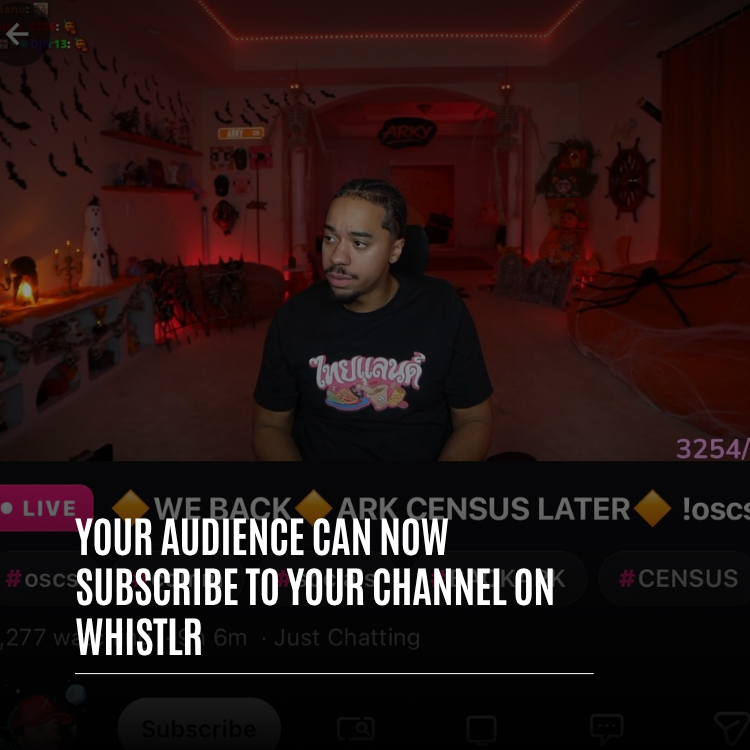
Live polls are built for right now: brief, snappy and experienced together by everyone tuned in.
- Mid-stream, open your host options.
- Choose Start a poll.
- Enter a question of up to 80 characters and two to four options of up to 30 characters each.
- Set it for 1 min, 3 min or 5 min.
- Tap Start poll and it appears on everyone's screen with a countdown.
Each viewer gets one vote and sees results right after voting; everyone sees them at the end. You, as host, can watch results the entire time, and End poll in the same menu closes it early if the outcome is obvious. Finished polls are stamped "Poll ended" with the winner highlighted, a perfect cue to react on stream.
How polls are moderated on Whistlr
Polls are content, so they pass through the same moderation as anything else you post or send.
- Note polls: your text, question and every option are reviewed together before publishing, and again if you add a poll during an edit.
- Live polls: reviewed when you tap Start poll; anything that fails isn't created, and you'll see the usual warning.
- Reporting: if a post with a poll breaks the Community Guidelines, report the post as you would any other.
- Pulse questions: these aren't authored by members; they come from the outside forecasting data and appear as supplied, with their categories and descriptions.
How creators and businesses can use polls and Pulse
A poll is one of the simplest ways to hear from your audience, and it requires no special tools or account type. Any account can post a Note with a poll, and anyone streaming can start a live one.
| Audience | Ideas |
|---|---|
| Creators | Let followers choose your next video, cover song or recipe, then deliver; keep a No end poll open about the best time to stream; drop a one-minute live poll when chat goes quiet; post a Pulse question in a Note with your reasoning and ask whether people agree |
| Businesses | See which flavor, color or product people want most before committing; let customers pick what you showcase next or discuss in your next live; use quick polls to learn what regulars care about |
Small things that make polls work better
- Remember what Pulse numbers are. They come from outside forecasting data, not from Whistlr voters, so siding against them is part of the game.
- Pause before tapping. Both Pulse votes and poll votes lock instantly.
- Set the scene. A sentence of context in your Note makes a poll much easier to answer than a bare question.
- Write tight options. Note poll options cap at 25 characters and live poll options at 30, and brief choices are quicker to scan.
- Match the timer to the question. One day suits a quick take, one week a bigger decision, and No end a question you want to leave open.
- Use live polls to wake up a quiet chat. One to three minutes is plenty.
Five spare minutes is enough to try both. In Notes, scroll until "Trending on Pulse" appears, open a question in a category you follow, glance at the 1W chart, lock in your answer and send it to the friend most likely to argue. Then tap Create, add a sentence of context, hit the Poll chip and ask something of your own.
Frequently asked questions
What are Pulse Markets on Whistlr?
Pulse Markets are free yes-or-no questions about real events in politics, sports, finance and culture. Every card shows the current Yes figure, a chart and the date the outcome is due. They appear in the "Trending on Pulse" blocks inside the Notes feed and through links friends share.
Does Pulse on Whistlr cost money or Gems?
No. Taking part is free and has nothing to do with money, Gems or any balance on your account. Nobody wins prizes, and there's nothing to buy, sell or trade. Think of it as an opinion poll about the real world.
Where do Pulse percentages come from?
They're drawn from public prediction-market data that Whistlr refreshes several times a day, and they show how likely the wider world considers each outcome. Whistlr votes are counted separately, so casting yours leaves the figures unchanged.
Can I change a Pulse vote after I make it?
No. Every question accepts a single vote, and it locks the moment you choose Yes or No. Your pick stays lit with a padlock and remains on the page after the question resolves.
How do I put a poll on a Whistlr post?
Open Create, write your Note, then pick the Poll chip. Add a question of no more than 140 characters, between two and four answers capped at 25 characters each, and a length: one day, three days, one week or no end. Polls are for text posts only.