Opinion · October 21, 2026 · 10 min read
Why Whistlr Built the Feed Before Communities: People First, Structure Second
Why Whistlr built the feed before communities like Circuits and Havens, how the two work together today, and what feed-first means if you want to start a group.
Whistlr built the feed before communities because a group needs members before it needs a rulebook. A discussion board with no one on it is an echoing hall; a feed is useful on your very first day, even if only three friends are in it. So the home feed shipped first, well ahead of Circuits, SubCircuits, Havens and most of the group features people lean on now. Those communities later grew out of the friendships, back-and-forth and shared tastes the feed had already set in motion.
Every social app eventually chooses a starting point: help people share their lives with each other, or hand them topic rooms to gather in. We picked sharing, deliberately. Over the past year the pieces arrived one at a time: friend-first ranking, Circles with Friends and Peers, Havens on the map, then Circuits for focused discussion. Each launch stood up on its own, but together they follow a plan. This is the reasoning behind that plan, how the feed and communities cooperate today, and what it means for anyone hoping to start a group.
What does "feed before the forum" mean on Whistlr?
We use those two words in a precise way. "Feed" means the flow of updates from friends and creators you follow, whether that's Notes, photos, Minis, Stories, live streams or whatever is unfolding near you. "Forum" means the organized, subject-led side of a platform: named groups with moderators and rules, discussion broken into threads, and an archive you can scroll back through months later.
Whistlr offers both now, and we value both. The earliest builds, though, revolved around a home feed and the vertical Minis feed. Community features came afterward in stages: Circles for sorting your people, group chats for carrying conversations on, Havens for tying groups to real-world spots, and lastly Circuits and SubCircuits, our threaded forum-style communities, which launched in June 2026.
That sequence wasn't about convenience. It reflects a conviction we've had from day one: groups don't begin as structures. They begin as people who already recognize and trust one another. The feed is where those bonds take shape; the forum is where they deepen.
Why forums can't come first: the empty room problem
Forum-first platforms often stall for one simple reason. A forum is a building full of rooms, and rooms are only as lively as their occupants. Open the doors with a hundred handsome communities and nobody inside, and each visitor walks into silence. They ask something, hear nothing back, and leave for good. The industry term is the cold-start problem. Around here we just call it the empty room.
Feeds are far more forgiving. Follow a handful of friends and there's already something to read. Post once and your followers see it. A great first day on Whistlr doesn't depend on joining a crowd of thousands; it depends on a few people you care about and somewhere their updates land.
Members first, bylaws later
Real-life groups rarely start with paperwork. A running club usually begins as two friends jogging on Saturday mornings. Then a coworker tags along, then a neighbor who keeps passing them on the trail joins too. Only once there are enough runners and enough shared history does anyone bother with rules, roles or a fixed meeting point.
Online groups behave the same way. A Circuit's rules, moderators, pinned threads and flair tags are genuinely useful, but only after a set of people has decided they want to keep talking. Launching the forum first would have been like drafting a club constitution before a single member had signed up.
The feed supplies the ingredients
In the feed you encounter people, start to recognize names and build the light, repeated contact that slowly turns strangers into peers. You notice someone's posts a few times, leave a reply, get one back, and end up following each other. So when someone eventually wants a Circuit for film photography or a Haven for their block, the feed has already introduced them to their likeliest first members.
| Ingredient | Where it comes from | Why a community needs it |
|---|---|---|
| Recognition | Spotting the same names and faces again and again | People feel familiar long before they join anything together |
| Reciprocity | Replies, Echos and shares flowing both directions | It's the strongest evidence two people want to hear from each other |
| Shared interest | What people post and engage with | It shows which subjects people care about enough to dig into |
| Trust | Relationships built over weeks and months | A group seeded by people who know each other opens with goodwill |
Rooms don't make a community; people do. We waited to build the rooms until people had reasons to keep talking, and that timing was the whole point.
— The ETAPX team
What the Whistlr feed had to get right first
Feed-first only pays off if the feed genuinely brings people closer. One that rewards noise, hides your friends or turns posting into a performance will never produce healthy groups, however polished the forum built on top of it. So before tackling communities, we concentrated on three things.
1. Sharing needed to feel light
Groups are built from contributions, and people only contribute when it feels low-stakes. A lot of early effort therefore went into lowering the bar. Notes let you post words alone, no photo required. Minis made short vertical clips fast to film and fast to watch. Stories gave everyday moments a home that doesn't sit on your profile permanently. Thoughts, the brief status above your avatar, turned a passing mood into a few seconds' work. More sharing means more raw material for conversations worth moving somewhere dedicated later.
2. Your people ahead of everyone else
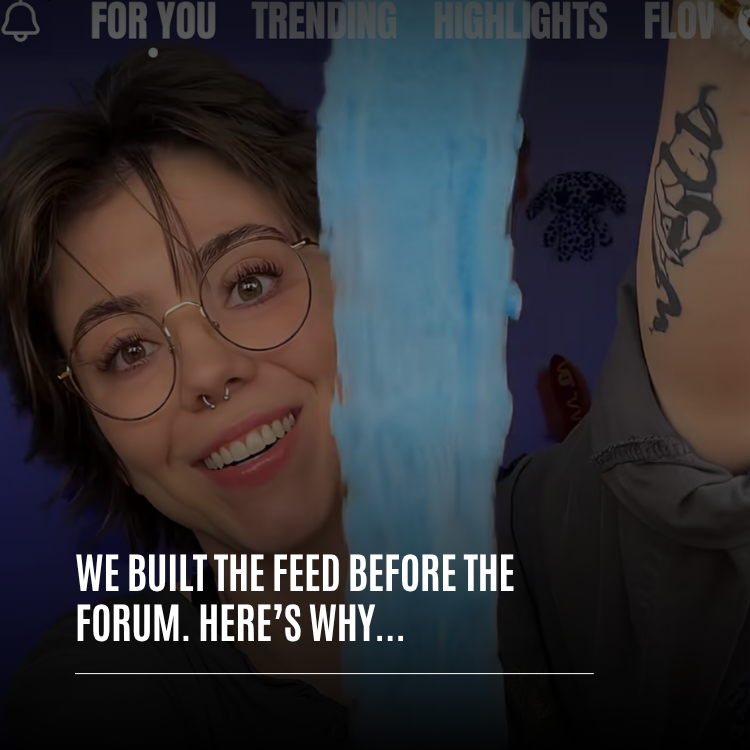
Next came the question of who you see. Home on Whistlr has always opened with what you picked: friends, creators you follow and communities you've joined. Broader material like trending moments, news and sports adds context without taking over. The top of the feed follows suit. Rather than a single mystery stream, it offers named destinations, including Trending for what's moving now, Highlights for standout moments and Flow for live streams, so you steer your own attention.
3. Ranking that rewards intent
Third was ordering. A feed tuned for instant reactions eventually fills with whatever shouts loudest. Whistlr's feed counts deliberate actions much more heavily than passive ones.
- Replies lead. A reply, particularly between two people who follow each other, is among the strongest signals there is.
- Passing something on is an endorsement. Sending a post to a friend or copying its link puts your own name behind it, which counts for more than a like.
- "No thanks" is information. Not interested, mute, block and report all push content down, and they're weighted heavily because each one is a conscious choice.
- Variety is protected. The feed caps how often a single author shows up back to back, so no one voice drowns out the rest.
Those happen to be the very behaviors a good community depends on: talking, recommending and politely declining. By teaching the feed to prize them early, we made sure the people who later launched groups were already skilled at starting conversations.
How Whistlr communities grew out of the feed
With the feed working, group features arrived in layers, each resting on relationships that already existed.
- Home feed and Minis: the base layer, where you share your life and keep up with the people you care about.
- Circles: a way to sort the people you already know, later sharpened with Friends and Peers so best friends and classmates or collaborators needn't share a bucket.
- Group chats: where a conversation that began in the feed continues privately among those involved.
- Havens: place-based communities on the Nearby map, linking people who share a location, with private versions only your mutuals can see and enter.
- Circuits and SubCircuits: focused, threaded groups with their own names, rules, moderators and front pages, built for discussions that should outlive a scroll.
Notice which way the arrow points. Each layer starts with people you're already connected to and moves outward toward more structure: Circles sort existing ties, chats deepen them, Havens gather people around a place and Circuits gather them around a subject. The forum arrived last because it relied on everything earlier to supply people worth gathering. When Circuits launched, users already had followers, friends, peers and group chats. Nobody was starting from nothing; they were giving an existing conversation a permanent address.
Why Circuits aren't just part of the feed
Reasonable question: why make Circuits a separate destination? Why not bolt threads and groups onto the feed and stop there? Because feeds and forums excel at opposite jobs, and forcing one to do the other's weakens both.
Feeds live in the present. They're superb at showing what friends posted today and what's happening this hour. They're poor at memory. A brilliant exchange in a feed fades the moment it scrolls past, and locating it next month is close to hopeless.
Forums are built to remember. In a Circuit, each thread has a title, a body, a vote score and a comment tree in which every reply hangs beneath the comment it answers. Moderators can pin a thread to keep key context on top or lock it once the discussion is done. You can sort by hot, new, top or rising, and each community owns a handle that works as a shareable address. None of that suits a fast feed, and all of it matters to a group that wants to endure.
| Space | Designed for | Shines at |
|---|---|---|
| Feed | Quick, personal, friend-first sharing | Keeping up with your people and what's happening now |
| Circuits | Deliberate, organized, subject-led discussion | Going deep on one topic and building a shared record |
| Havens | Location-led communities | Connecting people who share a place on the Nearby map |
| Group chats | Private, everyday talk | Daily conversation with the people closest to you |
Keeping them distinct lets each be tuned for its purpose. The feed needn't slow down to host long threads, and Circuits needn't race to match a feed's pace.
How the Whistlr feed and communities work together today
Separate isn't the same as sealed off. With a mature feed and a growing roster of communities, traffic now flows both ways, and this is where starting with the feed really earns its keep.
Threads that come to you
Home now blends several card types: posts from accounts you follow, threads from Circuits you've joined, live streams and clearly labeled sponsored items. When one of your communities is in the middle of a great discussion, that thread can appear next to your friends' updates. There's no need to make the rounds of every group you belong to; the best material finds you, and a tap opens the full thread with its nested replies and votes.
Posts that turn into groups
The path also runs in reverse. A Note that draws fifty replies hints at a conversation with legs. A creator whose followers keep asking the same questions is looking at the seed of a community. Since the feed already reveals who's engaging and about what, it's easy to tell when a discussion deserves its own room. The composer even lets you switch between posting to followers and posting into a community, so moving a conversation doesn't mean leaving familiar territory.
The feed also helps Whistlr recommend communities that fit. The interest categories you choose at sign-up, the subjects you engage with and the people you reply to all shape which groups get suggested, and a forum starting from zero would have had no such clues to work with.
What feed-first means if you want to build a community on Whistlr
Our product philosophy doubles as practical advice: the sequence that worked for the platform tends to work for individual groups as well.
- Fill your feed with real people: friends, creators and accounts you actually want to hear from.
- Post and respond. Share Notes, photos and Minis, and reply to what interests you; conversation is how you find your people.
- Sort your relationships with Circles and Friends and Peers so the right posts reach the right people.
- Track replies over reach. Views tell you who noticed; replies tell you who wants to talk, and that's the clearer sign a community is forming.
- Join groups that match your interests. Browse Circuits and Havens tied to the subjects and places you engage with most, and their threads will start appearing on Home.
- Launch a Circuit when the same faces keep returning to the same topic and good exchanges keep getting buried. Name it plainly, describe it in a sentence or two and set a handful of rules.
- Bring your regulars along. Invite the followers, friends and peers already in the conversation so the group opens with energy, not silence.
- Keep both spaces busy. Share your group's best threads back to the feed and pull lively feed discussions into the group.
Public communities are easier for strangers to stumble on. Private ones let you approve each member, which suits tight-knit or sensitive subjects, and Havens can be private too, visible and open only to your mutuals. Either way, the strongest groups on Whistlr feel like gatherings of people rather than content channels.
Will Whistlr keep adding community features?
Yes. Whistlr grows in layers, and communities will keep evolving next to the feed. Every new addition will follow the same rule as everything above: start from genuine connections and only layer on structure once people ask for more depth. People before structure; conversations before communities. Open your feed, start talking, and once a conversation is ready for a home of its own, build it one.
Frequently asked questions
Why did Whistlr build the feed before communities?
Because a group needs members before it needs structure. An empty forum feels lifeless, whereas a feed is worth opening on your first day even with only a handful of friends. The connections, conversations and shared interests the feed produced became the raw material for Circuits, SubCircuits and Havens.
How is the Whistlr feed different from Circuits?
The feed is a fast, friend-led stream about what's going on today. Circuits are organized, subject-focused groups with threads, nested replies, voting, moderators, rules and a handle you can share. One serves the moment; the other keeps discussions that are meant to last.
Do Circuit threads show up in my Whistlr home feed?
Yes. Threads from Circuits you've joined can appear on Home among updates from accounts you follow, live broadcasts and clearly marked sponsored cards. A tap opens the whole thread, nested replies and votes included.
How does Whistlr rank my home feed?
Intentional actions such as replying, sharing or sending a post to someone count for far more than a quick like. Not interested, mute, block and report all lower what you see, and the feed limits consecutive posts from one author to keep things varied.
When is it time to start a Circuit instead of just posting?
Once a familiar group keeps circling back to one subject and good exchanges keep disappearing down the feed. A Circuit gives that discussion a permanent home with threads, nested replies, pinned posts and rules. Bring in the people already talking so it starts busy.